Letter to My Younger Self

Dear younger self,

I’m so sorry for all the feelings you’ve been having all this time. I’m sorry no one listened to you. It must have been so hard to keep it all inside. But I want you to know now that it’s okay to feel. You deserve to have feelings. Your feelings are valid, and they are yours. No one can take them from you anymore.

It’s okay to feel confused. Mommies and daddies aren’t supposed to hurt their children. There’s nothing wrong with you. There never was. Mommy and daddy told you that so they could keep hurting you. It was all lies.  I’m so sorry they confused you. You may never understand why all those times, daddy chose to hold your hand instead of pushing hers away. He was wrong. She was wrong. But you were not wrong. You were just a child.

It’s okay to feel afraid. Instead of fearing monsters, you feared mom and dad. It must have been so scary for you. You had nowhere to hide. I’m so sorry you had to live in constant fear. But you were always so strong, even when you felt afraid. You are one brave little girl.

It’s okay to feel scared. Mommy and daddy made you believe that the world was scary and full of bad people who were going to hurt you. That wasn’t the truth. That’s what mommy and daddy told you to make you stay. The real scary place was home, and the scariest people were mommy and daddy. I’m sorry you feel so scared. It’s not fair. You don’t ever have to go back home again.

I know you feel empty. Mommy and daddy made you believe that you had no purpose, that you were worthless. That must have hurt your heart so much. I’m so sorry for your pain. But the truth is, there are so many good things inside of you that mommy and daddy never wanted you to see. Now you can let those good things free.

I know you feel lonely. Mommy and daddy kept you away from everyone. You were never allowed to talk to outsiders. Mommy and daddy told you that no one would ever understand you, that no one could be trusted. But that was all lies. I’m so sorry they lied you. It hurts to be alone. But there are people here to help you now, to help you feel less lonely. You don’t have to hide anymore.

I know you feel small. All of the bigger people around you didn’t help you. They didn’t notice you were desperate to be saved. It must have hurt so much to feel invisible, to have no one see your pain. I’m so sorry no one let you know how important you were. I see you, and you’re not small. You’re a little girl with a big heart, and you matter. You always have.

It’s okay to feel angry. You can be mad at mommy and daddy. They hurt you, and you didn’t deserve to be hurt, ever. You can be mad at the other adults who didn’t listen to you. They should have helped you. You can be mad at world. You deserved to have good parents, and you didn’t get that. I am so sorry for all of the hurt they caused you. I’m so sorry for all of the anger you’ve had to keep inside. But it’s okay to be angry. You deserve to be angry. I’m angry, too.

It’s okay to feel sad. Mommy and daddy told you it wasn’t okay to cry. They told you that you had no reason to be sad. They hurt you. But they were wrong. I’m so sorry. It must be so hard to hold that hurt in your heart for so long. But it’s okay to be sad now. No one will punish you. It’s okay to cry. You won’t get hurt. You can cry for the childhood you didn’t have. You can cry for the mommy and daddy you wished you had. You can cry for all the times they hurt you. You can cry. You can be sad.

It’s okay to feel hurt. You were wronged, in so many ways you were wronged. The grownups in your life failed you. Your mommy and daddy hurt your heart as much as they did your body. You had to learn to live with the pain. You deserved to be comforted and supported and nurtured, and instead you were hurt over and over again. It wasn’t fair. I’m so sorry that you are hurting.  I wish there was a Band-Aid I could give you that could make your hurt go away. I want you to know now that mommy and daddy can’t hurt you anymore.

I know you feel hopeless. Mommy told you that you would never be away from her. You thought that she would keep hurting you forever. I’m so sorry that you were hurting so badly that you wanted to die. You were just a little girl, in so much pain. Someone saved you from drowning, but no one saved you from what led you there to begin with.  I want you to know that you are safe now. Mommy can’t hurt you. You don’t have to die anymore.

I know your heart is broken. My heart breaks for you. You are just a little girl. A beautiful, intelligent, strong, kind, amazingly courageous little girl.

I know you feel unloved. Children are supposed to be loved by their parents. But something was wrong with mommy and daddy and I guess they missed that memo. It’s not your fault they didn’t know how to love. It doesn’t mean you are unlovable. You are so loved. There are good people out there who want to love and care for you. You deserve love and care. You deserve to feel good feelings, too. You deserve so much, and I want you to know that.

Thank you for being so strong. Thank you for being you. Thank you for helping me get here. I love you.
The mug is broken

You drop your favorite mug. The handle breaks. It’s a clean break, so you grab some glue and dab it on, let it dry, and your mug is good as new again. You can’t even tell it was ever broken.

This time, you drop your favorite mug and it’s not such a clean break. Instead of just the handle, the mug breaks into four or five pieces. You try to glue it back together. It looks good, but it doesn’t hold water so well anymore, slowly leaking through the smallest cracks. So you repurpose it, you put it on the shelf so you can still admire it every day. It still lives on.

Now imagine that same coffee mug. It has taken a plunge from seven feet high onto the hard linoleum floor and broken into a hundred pieces. Chunks of porcelain here, flecks there. You can’t even tell where the pieces belong, they’re so broken.

Some pieces have to be thrown away because they have been so damaged from the fall, they can’t be saved. That leaves empty spaces in the mug, holes that cannot be filled. That means the mug has lost its purpose, because with all of those holes, the mug won’t be able to hold any water.

You make a wholehearted attempt at gluing the mug back together. You take your time, you glue the pieces back with precision. But as you’re trying to fix it, it breaks even more.  As you focus on putting the pieces together on one side, the pieces you glued on the other side are coming undone. Nothing seems to be coming together right. None of the pieces are fitting back together like they’re supposed to.

Then you realize there’s too much missing, too much irreparable damage done. You can’t save that mug, no matter how hard you try, no matter how much time you take, no matter how much patience you have. It’s all a fruitless effort. You need to give up on it. It needs to be thrown away.

Because even if you spent all the time in the world gluing that mug back together piece by piece, there’s not any glue in the world that could ever make it whole again.

I cannot be whole again.

The Things I Did When I Was Hopeless

I never expected this life.

I never expected to be able to step out the front door and walk down the street; before, I was not allowed to leave the house by myself for any reason.

I never expected to be able to check my own mail; before, I never even had a key to the mailbox.

I never expected to be able to lock my bedroom door and sleep at night without fear of being abused; before, I could never rest easily, knowing that my mother could come in at any time.

All of the things my mother told me would happen, they haven’t come true.

She told me that no one would ever like or love me, but I’ve made friends here.

She told me I would never amount to anything, but I’m doing great things.

She told me I could never live without her, but I’ve been living without her now for 13 months.

I wish I would have known that my life would be this different before I did the things I did when I was hopeless.

For a long time, I was a prisoner serving a life sentence with no chance of parole. I tried to reach out for help, and people turned away. I tried to run away from home, but my mother found out every time. I tried, for so long I tried to get free, and instead I ended up trapped even more. So I gave up. I lost all hope. I believed that I was going to spend the rest of my life in that hell.

I was living a shell of an existence, leading a life of pain I didn’t want to prolong any more than I had to. I had no access to a gun, or I would have ended it right then and there. I made several attempts to end my life as early as six years old, but none of them worked. All it got me was damaged kidneys and an even deeper sense of hopelessness.

So I found covert ways to slowly kill myself. I swallowed pills like tictacs, knowing they would damage my kidneys even more. I banged my head against walls and gave myself concussions, hoping one time that I would pass out and never wake up. I drank until I blacked out, hoping I would eventually get to a point where it would be enough to finally crash my system.

And I smoked. I knew that smoking was a guaranteed risk for me. I had already been struggling with asthma and chronic pneumonia since I was 14 years old. I knew that smoking would make me sick. I knew that it would further damage my already damaged lungs. This. This was my ticket to death. This was my escape from hell.

I smoked for years. Even as I felt the pressure building in my chest, the familiar feel of fluid accumulating in my lungs, I continued to smoke. It got to a point where breathing was no longer automatic; it was an effort. It was painful. Not being able to breathe is a scary feeling, one I’m not even sure I can adequately describe to someone who has been lucky enough to never experience it. But every time I became gravely ill, every time I could hear the crackling in my lungs with each breath I took, I secretly hoped it would be the end for me. The pain it caused was nowhere near the pain I felt existing in the prison I was in. I was hopeless.

I did not expect to make it here. I did not expect to escape. I am free now, but all those things I did when I was hopeless have followed me. The scars will fade, the bruises heal.

But my COPD will not go away. And I can’t help but blame myself. I know that it’s not just one thing that caused it. I was medically neglected. I lived in filth and breathed in mold spores every night. I worked five days a week in a dusty warehouse, inhaling so much dust that I would cough up gray mucous every night. But I also smoked. Because I wanted to die. And that’s all I can think about.

When I see an older person on the street, I wonder if I will ever make it to that age. I think about all of the things I will miss out on, the good and the bad. I missed out on my entire childhood. I lost my adolescence. I lost 11 years old my adulthood. And I’ll likely lose most of my elderhood. All because I was so hopeless, I did things I knew would kill me, because I never expected to be free.

When I was first diagnosed, I existed in a world of conscious denial for a while. I told myself that I had nothing to worry about, that I was young, that I didn’t need to take my medications because I felt okay. I acted like I was invincible to the effects of the disease. Then I learned that someone had passed away from COPD – a woman who was only one year older than me. I grieved for her, and I also began grieving my own death. No longer could I tell myself I’m young. I could end up dead. I am not immune.

The irony is that, if this were two years ago, I would have gladly accepted death. I wanted it, because death was the only way I thought I could escape my mother’s abuse. But I don’t want to die. I’ve experienced a life I never expected to live, and I don’t want to lose that any earlier than I have to.

While there is a small part of me that still holds on to hopelessness, that still wants to die, there is a larger part of me that wants to live.


Emotionally Illiterate

There is an enormous amount of learning that occurs in the first years of life. I’m not just talking about the usual: learning how to talk, learning how to feed, and learning how to the use the potty. I’m talking about the things that people don’t realize: how children learn emotions.

Infants emulate their parents, including facial expressions. As they grow, they learn to associate emotion words with their expressions, with the help of their caretakers. Toddlers learn to identity emotions, and children learn to regulate emotions in the early years of schooling.

But what happens when a child’s caretakers are emotionally empty?

An infant can’t emulate emotions she doesn’t see. A mother who is never happy or joyful cannot show her baby how to show happiness or joy. This hinders the development of emotional literacy. Children can learn about emotions in school, but when there is no emotional learning going on at home from an early age, the child misses out considerably, and the effects are long-lasting.

My mother was (and still is) a sociopath. She cannot express genuine emotion. She never has. The only emotion she ever expresses is anger. She is void of happiness (and a lot of other things, but we won’t go there right now). It is no surprise, then, that I grew up emotionally illiterate.

Of course, as a child, I didn’t know what emotional literacy was or what it entailed. I remember people defining their emotions: happy, sad, surprised, mad. I knew they were emotions, but I didn’t really comprehend anything beyond that. I never felt them, or at least understood that I felt them. I knew what anger was, because I experienced it through my mother and father regularly. And as a result of their anger, I knew fear like it was my best friend. The rest was a mystery.

My facial expression has been consistently “muted anger” since I was a child. Many people accused me of being angry, and I didn’t understand because I wasn’t feeling angry at all. But my natural facial expression was typically angry. Because that is the only facial expression I experienced as an infant. It’s the only facial expression I was able to emulate, and I carried that with me through life.

I learned quite a bit about emotions when I was around my peers in school. I finally started to identify feelings within myself, only to have them trampled upon by both of my parents.

I remember one time, I had an About Me project in elementary school. I chose to write with the marker colored bittersweet, because I said my life made me feel bitter. My mother became enraged when she heard, and I was punished severely. She told me I had no reason to feel bitter, and that I should be grateful for the life she was giving me. A 9(ish) year-old who identifies feeling bitter about life should be a red flag for anybody. But of course, my mother believed she did no wrong, so she just burned that flag to the ground.

Then there was the incident when I was a teenager. My high school guidance counselor called my parents, concerned that I was significantly depressed. I was. But feeling depressed was not allowed in our family. Feelings in general were not allowed. And I was punished severely for it. For years after that incident, I became emotionally constipated. I made myself numb to protect myself from my parents. I showed or felt no emotion because I did not want to experience the pain I felt that night ever again. The little bit of emotional knowledge I had was buried deep inside of me, never wanting to be dug up.

My issues are complex (!). First, I had a rough start in life being raised by a sociopath, so I spent a good portion of my childhood emotionally illiterate. Second, what little emotional knowledge I did have became muddled in my adolescence, and pushed down into the crevices of my semi-conscious mind.

So now, at the age of 30, I find myself needing to learn emotions all over again. And yes, sometimes I feel like a five year-old. I read children’s books on feelings. I have charts with emotion words and flashcards with feelings on them. My therapist draws faces depicting different emotions that I try to guess.

Whenever I correctly identify a feeling in myself, my therapist praises me like you would praise a small child. Because that’s what I need. Because I am so emotionally inept. I am an emotional illiterate.

But I’m learning what it means to have feelings again.

Complex

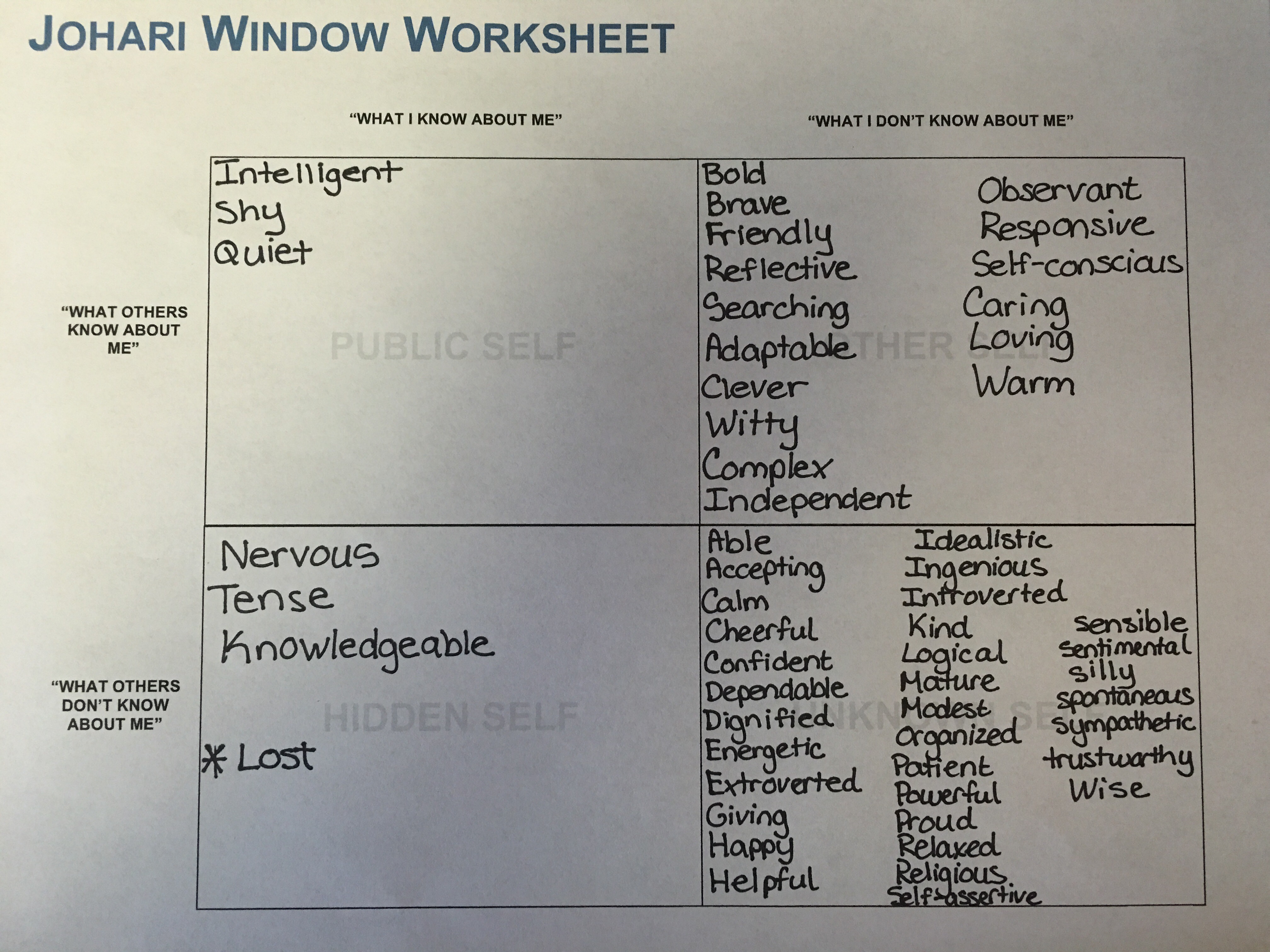
One of the activities in yesterday’s group therapy was to create a Johari Window.

Each person chose six of the 57 adjectives listed to describe themselves, and then chose six for each other person.

It was so easy for me to choose adjectives to describe everyone in group. But when it came to choosing my own, I became frustrated. The adjectives on the list were mostly positive – too positive for my own liking. I struggled just to pick three. Intelligent. Nervous. Tense. Those words were definitely accurate for me. I could never deny my intelligence, even though I oftentimes wish I had less of it. Nervous and tense are words I associate with anxiety, and anxiety is my normal.

Well after everyone else was finished, I was still struggling to finish my own six adjectives. I quickly scanned the sheet again and choose three more: Knowledgeable, quiet, shy. I think knowledgeable pairs with intelligence. I have a lot of knowledge about a lot of things, probably more knowledge than I need. Quiet describes me sometimes, depending on the day, the amount of coffee I’ve had to drink, and how present I am. Shy, for sure. People scare me.

Then I received seven lists, each with six adjectives the others in group used to describe me. I went through the lists and wrote down each adjective in the appropriate window.


Not surprisingly, most people chose intelligent. At least I was right about something about me. I couldn’t argue with that.

Then I came across the words brave, bold, and independent. Everyone put brave. Me. Brave. Clearly they don’t know me, I said to myself. Brave would have been standing up for myself. Brave would have been fighting my mother and telling her to stop hurting me. Brave would have been hitting my father back after he beat me. Brave would have been running home at age 15, not at age 29. Bravery, no. Weakness, maybe.

Bold, I am not. Being bold is being fearless. Bold people don’t hide in the closet when someone knocks on the door. Bold people don’t get scared to check the mail, afraid a letter from home will appear. That is not being bold. Clearly these people don’t know me.

Independent, not me. I can barely decide what to eat for dinner. I can’t make my own decisions, or live my own life. I need other people to make decisions for me. I never had the ability to be independent. I spent more than 29 years in forced dependence on my mother, and now even though I am free, I feel lost without anyone here to make decisions for me.

Then I came across a word that set off a bit of internal rage. Complex. The second list I read through, and someone had circled complex. I blew it off, until the next list had complex circled as well, and then another list, and another. By then, I was just angry. At who, I am not sure. How could these people call me complex? I’m not complex. They don’t even know me.

As I sat with my own thoughts and slight inner rage, I realized the negative associations I had formed with that word. This wasn’t the first time I was told I was complex. I’ve heard it several times before, and never in a positive way. I heard it from therapists as their reasoning for not being able to help me. You’re too complex. Shit, I didn’t know therapists only worked with certain difficulty levels. I’m sorry.

Complex meant I was too complicated, too broken, too difficult to be helped. That word hurt me, multiple times. And here it was, coming up again and hurting me still.

I decided to share my difficulties with that word with the rest of the group. In response, some people explained what that word meant for them, and why they chose it. It wasn’t at all for reasons I had associated complex to be in my head. I was complex because there was more to me to get to know, more than what you see on the outside. I was complex because I was interesting. I was complex, as one of my therapists put it, because the gap between what I think and believe I can do and what I actually do is so large. I don’t believe I can do anything right, or even do much of anything at all. Yet I continually do these great things, and accomplish so much, despite the fact that it all goes against everything I believe about myself. I guess that it complex.

I guess, when I really think about it, I’m definitely not simple – the opposite of complex. Nothing in my life has ever been simple. I admit, at times, I desire simplicity. I crave ignorance. I want life to be uncomplicated. But that’s not going to happen, it didn’t then, it’s not now, and it won’t be in the future. And that’s okay.

Perhaps it’s not so horrible to be complex.

Perhaps those people in my past were just too simple to deal with my complexity.

The Stones of What I’ve Lost

I had group therapy today for my support group. It is something I look forward to every couple of months, even though the topics are somewhat difficult and I always end up crying at least once.

Today was no exception. I was actually doing quite well until the topics of anniversary dates and grief came up. I thought to myself, anniversary dates aren’t a problem for me. I’m over it.

But I decided to write down something anyway. April 25th. The day I tried to end my life by taking a more than lethal dose of aspirin. The day my family found out, and did nothing about it.

The memories flooded my mind and I couldn’t focus on anything else. I felt the pain again, the despair that was all too familiar. I tried to hold back my tears, and retreated back into myself. By the time the topic of grief came up, I was teetering in another place in my mind. I was back in 2008, reliving the pain of that day.

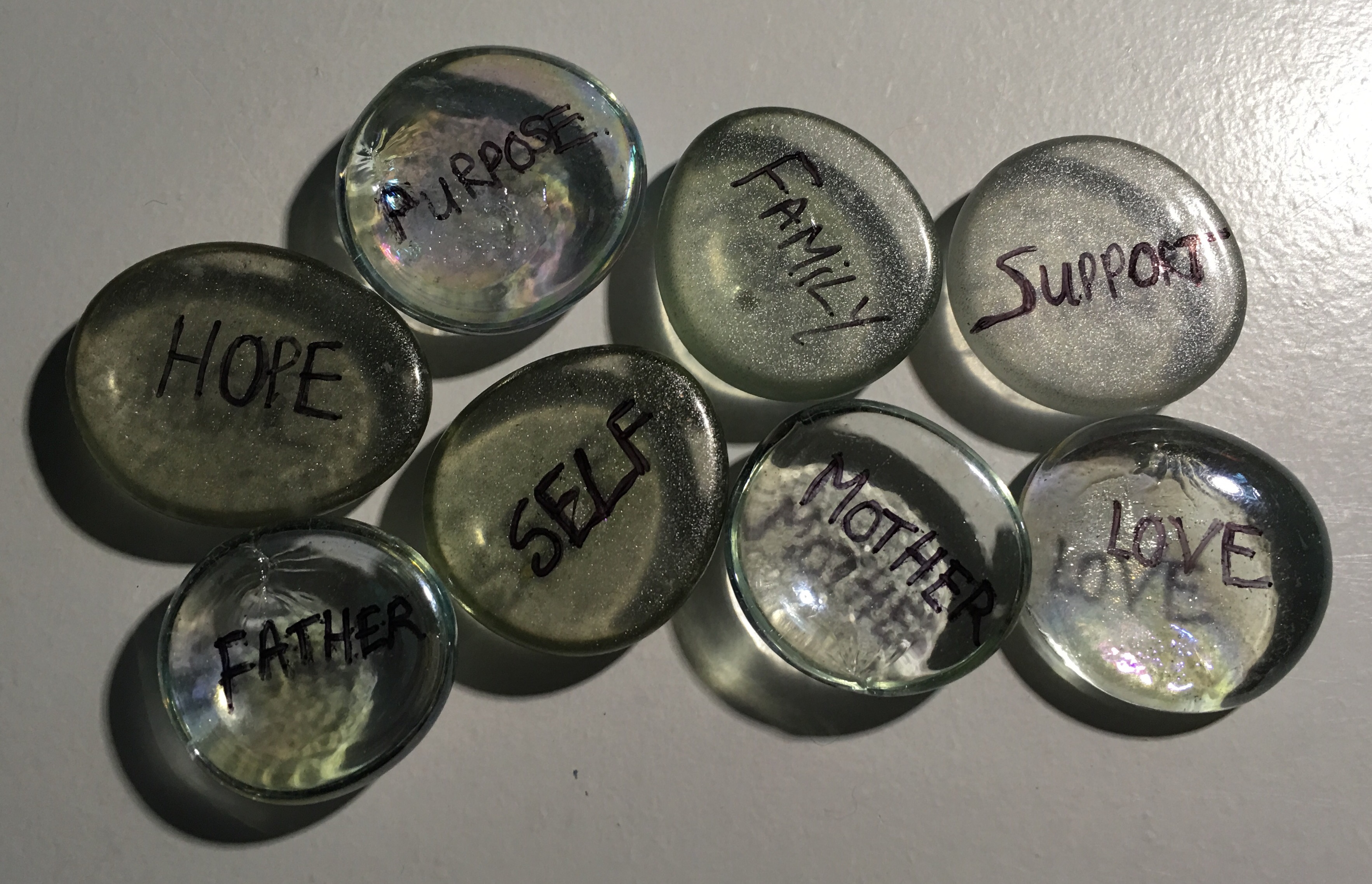
I was able to ground myself enough to work through the rest of the grief session. We each chose eight stones, and had to write something we lost on each one, something we grieved or are still grieving.

It didn’t take long for me to write my losses: Mother, father, family, purpose, self, love, hope, and support.


Simple words, that to the outside world, would never appear to be related to loss or grief. But they were, for me, the losses I still carry with me every day.

The loss of a mother, the mother I never had, the mother I always wanted, the mother I deserved, the mother I will never, ever have.

The loss of my father, not as much in his actual death, but the loss of the father he should have been, the man he should have been, the protector he should have been, the superhero he should have been to me and never was.

The loss of the family I no longer have. I didn’t just lose my parents when I ran away. I lost any connection to my brother. I lost the connection to anyone on my mother’s side of the family. I’m losing the connection to the very little family I have left, and I can’t change that.

The loss of my purpose. I believed so strongly that I was going to be a counselor some day. That is why I went through what I did. I was going to help people. I was going to right the wrongs that were done to me for so many years. But I lost that when my school showed me that my mental illness was all that mattered, not my skills or who I was on the inside.

The loss of self, the loss of my identity. Who am I? I still don’t know. I was never allowed to be anyone or anything other than what my mother told me to be. My identity is so fractured, both literally and figuratively. I’m not even sure that I lost myself, because I question whether or not I ever existed.

The loss of love, the loss of trust, the loss of ability to connect with people. I never experienced the love I should have gotten from the people who were supposed to love me but didn’t. I don’t know how to love because I never learned what love really is.

The loss of hope, strongly felt that April 25th night, when I sat alone, nearly dying, and my family didn’t care. The very little hope I had was shattered forever that night. I could have died, I should have died, and my family didn’t care. The loss of hope I continue to feel day in and day out as I realize the world wasn’t meant for me.

The loss of support, through 15 years of working with some of the shittiest therapists, the loss of support when I left everyone I knew behind so I could escape the hell that was my (former) home, the loss of support I feel when my therapist wants to send me away to the hospital, because even she can’t seem to help me.

I carry these losses in my heart every day. Now I have stones to carry with me, too. Because as much as I would like to throw the stones away, it’s not that easy.

I wish people could see these losses inside of me, and not just on these stones I carry.

There’s no need for any doctors

I’ve been dealing with a significant medical issue for the last ten days.

And when I say dealing with, I mean actively avoiding, pretending it’s not happening, and keeping my mouth shut about it, hoping it will resolve on its own. Because you know, that’s how I handle most things in my life. That’s how I was taught to handle most things in my life.

Medical avoidance is my norm. That is one thing I have carried on from my mother. She only took us to the doctor when it was required (because of school forms) or when I was near death. And even then, I was made to feel like it was some kind of burden on her for me to be sick.

Well before I was diagnosed with asthma at age 14, I kept telling my parents that something was wrong. I had to struggle to catch my breath. I felt like I was suffocating.

“It’s just allergies.”

Except it wasn’t just allergies. I suffered for a long time until my lungs filled up with so much fluid that I could no longer breathe. It wasn’t until then that my mother finally took me to the doctor. I probably would have died if she had waited any longer.

By then, the damage was already done. I spent the next 14 years in and out of hospitals, battling pneumonia and lung infections, living off of oral steroids and liquid Albuterol just to stay alive (and for those that may not know, oral steroids are simultaneously the best and the worst drugs ever).

I always waited until the very last minute to seek medical treatment. Concerned friends would tell me I was turning blue. “I’m alright, just cold,”I’d tell them. Then within the week, I’d be in the ER on oxygen. I wasn’t cold, I knew what was coming. I just was taught to think that I didn’t need medical care. I grew up believing that I didn’t deserve medical care.

And I’m still practicing that belief. I went to the doctor back in March, with my therapist, after her consistent prodding and encouragement. It was at that appointment that I was diagnosed with COPD. I haven’t been back to the doctor since. My prescription ran out, and I’ve been living unmedicated for months now.

I think I’m doing just fine, considering. My therapist is not as inclined to think so. We were discussing the impending hospitalization, and her reasons for wanting me to go. She mentioned me not receiving medical care.

“I don’t need medical care, I’m fine.”

“You have COPD, and you’re not getting treatment for that.”

“Yea but I don’t need it, I’ve been okay.”

“For now. But that’s not just something that can be put to the side.”

On a deeper level, I still feel undeserving of care. That ties into my even deeper belief that I am undeserving of love, and undeserving of life. Maybe I have COPD because I am undeserving of oxygen. Who knows.

I wasn’t even going to tell my therapist about my current issue. I had already endured enough of her semi-lecturing this session. But I found myself immensely tired during session. My therapist assumed it was related to not wanting to talk about the difficult stuff (which I admit, in the past, it has been). I kept telling her this was different, and she asked how I knew it was.

I finally told her what’s been going on. I knew it was just going to further prove her point about me needing to go to the doctor. Luckily for me, I squeezed in my admission right at the end of session, so I didn’t have to talk about it all that much. I’m sure I will hear about it on Thursday. Hopefully by then, the issue will be resolved and I can just say “see, I told you I was going to be fine.”

Or, it won’t. Either way, I’ll sit there and say everything is okay. I could be bleeding to death, and I’ll still tell you I’m okay.

That’s what I did in childhood. That’s what I do today.

Smile, it ain’t that bad.

On my way to therapy this morning, a man I had never met before stopped me as I was walking and said “just smile, it ain’t that bad.” Part of me wanted to slap him in the face, but I chose instead to keep on walking so I could get to my appointment on time.

Smile. I have smiled before, in the few moments of genuine happiness. But happiness is not something that comes easily to me. I’m not the kind of person that can force fake emotions. I can’t just smile if I’m not really happy. I am aware that a lot of the time, I look sad, miserable, and worried. Because I am sad, miserable, and worried.

I’m not smiling now, because my mind is racing with anxious thoughts about school. What if it’s too hard? How am I going to get the text books I need? What if they find out about my DID?

I’m not smiling now, because I’m worried about how I’m going to pay my rent next month, how I’m going to stretch my grocery budget so I can feed myself until September, what bills are going to have to be put off for next month, and what credit card I can max out so I can get my bus card.

I’m not smiling now, because I’m exhausted from work, a job I am lucky to still have because I get so stressed out sometimes that I dissociate and have trouble getting my work done.

I’m not smiling now, because I’m tired of constantly living in fear of my mother. I’m tired of having to calm younger parts and convince them we are safe, when sometimes I can’t even believe that myself. Fear takes away any smile.

I’m not smiling now, because I feel so alone. Even when I am surrounded by people, my ability to trust others is so shattered that I live in a constant state of fear of people.

I’m not smiling now, because I sat through my therapy session earlier this morning and cried as my therapist talked about inpatient hospitalization. Because I am a mess. I’ve been dissociating so much that I don’t even know when and if I am ever fully here anymore. Last week was so bad, that people were actually scared of me. And I don’t remember a thing.

I went to therapy last Thursday and barely remember what happened. Apparently it was obvious that I was not present. That seems to be the theme of my life lately. Not present.

I saw the concern on my therapist’s face. I tried to listen to what she was saying, but my mind was just going to other places.

The sinking feeling in your heart when you know your best isn’t good enough.

The hopelessness you feel when you realize you can’t be helped.

All of these things went through my mind. I’m not good enough at life. My therapist can’t even help me. She wants me to go to a hospital, and they’re not going to be able to help me. Then what? I can’t even miss work. I can’t afford it. This is a lose/lose situation.

Despite my doubts, I understand where my therapist is coming from. She is concerned that one little thing will happen and push me off the edge. Next month, when I start school again, it just may be too much for me to handle. I am on a roller coaster ride and she cannot ride with me. She can’t be with me all day, every day, to deal with issues as they come up. And even though I am (barely) managing that on my own, it’s not going to be that way every time. I am headed for a breakdown.

So no, I can’t smile. And yes, it is that bad.

Fall down, get up. Drop out, get in.

I still remember the day I got the call that I was accepted into grad school. It was such a happy day. I had such high hopes for my future. I was so excited to finally interact with people who were understanding and shared the same interests as me.

And then six months later, I dropped out of grad school because someone (or multiple someones) reported my DID and my blog and all of a sudden, my abilities came into question.

I didn’t just lose my place in grad school that day, I lost my dream. My wish of becoming  a counselor was ripped away from me, trampled on, shit on, and set on fire. All because I struggle with a mental illness.

From talking with others, I knew that going into the counseling field would be difficult for me. I could not be open about my DID, but that is impossible, considering my name is forever tied to DID through my professional writing. I didn’t feel like I should have to hide who I am, and unfortunately, many in the mental health field are not accepting of people with mental health issues themselves.

So instead of putting myself out there to be hurt again, I took a different route. I applied to different programs, still connected to psychology, but not focused on the counseling aspect. Quantitative psychology, neuropsychology, and experimental psychology – all programs that got my interest, and all programs that so many in the counseling field would never, ever consider because they find the science of psychology too difficult.

I have been stressing out for the last couple of months, worrying that I would not get into a program, and if I did, that I would not be able to start until next year. I found an experimental psychology program I really liked, contacted the head of the department and asked if he would still consider me for the fall semester (the deadline was already up months before). I scurried to get everything I needed in, rushed to take the GRE as soon as I could, wrote a different essay for each program I applied to, and waited the last few weeks with a tremendous amount of anxiety.

I got my acceptance letter just a few days ago, my first choice school and program. I’m starting in the Fall semester. I will even be working with my first choice mentor, conducting research in the area of affective neuroscience and environmental impact on emotional development. Basically, I will be focusing on the biological and environmental bases of emotion, and what causes emotions to “go wrong”.

Hopefully, no one will feel the need to use my diagnosis against me this time around.


Where do bad folks go when they die?

I’m not a religious person.

My family was religiously diverse. My mother sent her children to Catholic school (though that was more for show than it was for instilling the values of Jesus). We went to Church for the tuition discount. My mother also used God to justify some of her abuse, which drove me away from religion entirely.

I identify as an atheist, probably more so an agnostic. I think all of those years of Catholic schooling have left imprints on my brain, because there are times when I think about God’s existence and Heaven and Hell and all of that in between.

I also constantly found myself the lone atheist among those around me. At work, most people were Catholic. In my undergrad, I had classes with many severe Christians – and when I say severe, I mean the extremely judgmental Christians that give the rest a bad name. I tended to keep my views to myself because I wasn’t one for religious debates. People can believe what they want to believe.

Whenever someone makes religious comments towards me, I normally let it go, be polite, and move on. But the other day, an acquaintance of mine reached out to me concerning the death of my father. She said that my father would look down on me and be proud.

I felt sick. The thought of a person like my father gaining entrance into Heaven disgusts me. I thought Heaven was supposed to be for the good and just? My father was not good or just. He may have mellowed out later in his life because he became ill, but that does not excuse the person he was before he got sick, and the life he ruined, the heart he shattered, the soul he took away.

If people like him go to Heaven, I would much rather go to Hell. Some sins cannot be forgiven.

Some sins should never be forgiven.