There’s no need for any doctors

I’ve been dealing with a significant medical issue for the last ten days.

And when I say dealing with, I mean actively avoiding, pretending it’s not happening, and keeping my mouth shut about it, hoping it will resolve on its own. Because you know, that’s how I handle most things in my life. That’s how I was taught to handle most things in my life.

Medical avoidance is my norm. That is one thing I have carried on from my mother. She only took us to the doctor when it was required (because of school forms) or when I was near death. And even then, I was made to feel like it was some kind of burden on her for me to be sick.

Well before I was diagnosed with asthma at age 14, I kept telling my parents that something was wrong. I had to struggle to catch my breath. I felt like I was suffocating.

“It’s just allergies.”

Except it wasn’t just allergies. I suffered for a long time until my lungs filled up with so much fluid that I could no longer breathe. It wasn’t until then that my mother finally took me to the doctor. I probably would have died if she had waited any longer.

By then, the damage was already done. I spent the next 14 years in and out of hospitals, battling pneumonia and lung infections, living off of oral steroids and liquid Albuterol just to stay alive (and for those that may not know, oral steroids are simultaneously the best and the worst drugs ever).

I always waited until the very last minute to seek medical treatment. Concerned friends would tell me I was turning blue. “I’m alright, just cold,”I’d tell them. Then within the week, I’d be in the ER on oxygen. I wasn’t cold, I knew what was coming. I just was taught to think that I didn’t need medical care. I grew up believing that I didn’t deserve medical care.

And I’m still practicing that belief. I went to the doctor back in March, with my therapist, after her consistent prodding and encouragement. It was at that appointment that I was diagnosed with COPD. I haven’t been back to the doctor since. My prescription ran out, and I’ve been living unmedicated for months now.

I think I’m doing just fine, considering. My therapist is not as inclined to think so. We were discussing the impending hospitalization, and her reasons for wanting me to go. She mentioned me not receiving medical care.

“I don’t need medical care, I’m fine.”

“You have COPD, and you’re not getting treatment for that.”

“Yea but I don’t need it, I’ve been okay.”

“For now. But that’s not just something that can be put to the side.”

On a deeper level, I still feel undeserving of care. That ties into my even deeper belief that I am undeserving of love, and undeserving of life. Maybe I have COPD because I am undeserving of oxygen. Who knows.

I wasn’t even going to tell my therapist about my current issue. I had already endured enough of her semi-lecturing this session. But I found myself immensely tired during session. My therapist assumed it was related to not wanting to talk about the difficult stuff (which I admit, in the past, it has been). I kept telling her this was different, and she asked how I knew it was.

I finally told her what’s been going on. I knew it was just going to further prove her point about me needing to go to the doctor. Luckily for me, I squeezed in my admission right at the end of session, so I didn’t have to talk about it all that much. I’m sure I will hear about it on Thursday. Hopefully by then, the issue will be resolved and I can just say “see, I told you I was going to be fine.”

Or, it won’t. Either way, I’ll sit there and say everything is okay. I could be bleeding to death, and I’ll still tell you I’m okay.

That’s what I did in childhood. That’s what I do today.
Smile, it ain’t that bad.

On my way to therapy this morning, a man I had never met before stopped me as I was walking and said “just smile, it ain’t that bad.” Part of me wanted to slap him in the face, but I chose instead to keep on walking so I could get to my appointment on time.

Smile. I have smiled before, in the few moments of genuine happiness. But happiness is not something that comes easily to me. I’m not the kind of person that can force fake emotions. I can’t just smile if I’m not really happy. I am aware that a lot of the time, I look sad, miserable, and worried. Because I am sad, miserable, and worried.

I’m not smiling now, because my mind is racing with anxious thoughts about school. What if it’s too hard? How am I going to get the text books I need? What if they find out about my DID?

I’m not smiling now, because I’m worried about how I’m going to pay my rent next month, how I’m going to stretch my grocery budget so I can feed myself until September, what bills are going to have to be put off for next month, and what credit card I can max out so I can get my bus card.

I’m not smiling now, because I’m exhausted from work, a job I am lucky to still have because I get so stressed out sometimes that I dissociate and have trouble getting my work done.

I’m not smiling now, because I’m tired of constantly living in fear of my mother. I’m tired of having to calm younger parts and convince them we are safe, when sometimes I can’t even believe that myself. Fear takes away any smile.

I’m not smiling now, because I feel so alone. Even when I am surrounded by people, my ability to trust others is so shattered that I live in a constant state of fear of people.

I’m not smiling now, because I sat through my therapy session earlier this morning and cried as my therapist talked about inpatient hospitalization. Because I am a mess. I’ve been dissociating so much that I don’t even know when and if I am ever fully here anymore. Last week was so bad, that people were actually scared of me. And I don’t remember a thing.

I went to therapy last Thursday and barely remember what happened. Apparently it was obvious that I was not present. That seems to be the theme of my life lately. Not present.

I saw the concern on my therapist’s face. I tried to listen to what she was saying, but my mind was just going to other places.

The sinking feeling in your heart when you know your best isn’t good enough.

The hopelessness you feel when you realize you can’t be helped.

All of these things went through my mind. I’m not good enough at life. My therapist can’t even help me. She wants me to go to a hospital, and they’re not going to be able to help me. Then what? I can’t even miss work. I can’t afford it. This is a lose/lose situation.

Despite my doubts, I understand where my therapist is coming from. She is concerned that one little thing will happen and push me off the edge. Next month, when I start school again, it just may be too much for me to handle. I am on a roller coaster ride and she cannot ride with me. She can’t be with me all day, every day, to deal with issues as they come up. And even though I am (barely) managing that on my own, it’s not going to be that way every time. I am headed for a breakdown.

So no, I can’t smile. And yes, it is that bad.

Freedom, Part 2

It has been one year now that I have been free.

In the beginning, I didn’t think I was going to make it this far. I had limited finances, no job, no family, and no friends. I sat in my room the first few days and just got lost in my thoughts. I told myself I would enjoy freedom as long as I could, and then kill myself once I ran out of money. I had very low expectations, a lot of fear of the unknown, and a lot of anxiety about the world.

Many people don’t understand it when I say I ran away from home, that I escaped. Regular people just move out when they change locations. But I never had that ability. I ran away and ran towards freedom.

But even then, I could not run away from my mother’s programming. Even though I was physically free from her, I carried the same beliefs about the world that she had trained me to believe. She wanted me to believe the world was a scary place because that is how she kept her control over me. And when I moved away, I still thought the world was out to get me.

As the weeks went on, I started making small achievements. I took the bus all by myself. I crossed a busy highway. I went to the mall. I had conversations with strangers. I went to the grocery store and picked out new foods. I sat on my porch at night and looked at the sky. While these all sound like everyday things, they were not to me. They were things I was never allowed to do by myself.

Within a week, I started therapy. I already contacted my therapists before I even made my escape. They were ready and willing to help me. Therapy started out fine, and then all hell broke loose. After one month here, I dissociated so badly that it took two therapists to bring me back. That was when I got my official DID diagnosis, and I’ve continued therapy ever since. It’s been a couple hundred hours, thousands of dollars, and a whirlwind of emotions, but it has allowed me to be where I am today.

Within two weeks, I got a job. I had a couple of interviews lined up, but I decided to go with the first place that wanted me. In the long run, that ended up to be a great decision, because the people I work with are some of the most understanding, amazing people I have ever met in my life. The night before my first day at my new job, I ended up in the hospital. My PTSD was severe and I was admitted to the psych unit for a few days, without a phone and without a way to contact my job. I thought for sure that was it. I missed my first day and I was a no show. But they understood, and within 24 hours of being released, I started my new job, the job I still have today.

Within six weeks, I finished my thesis on mother-daughter sexual abuse. I received the highest grade of 99. With that, my undergraduate career was done with. I graduated with high honors and a 3.9 GPA.

Within two months, I was hired as a writer for a mental health website, writing about the disorder I was still in denial about. It was a challenge for me in many ways. Taking the position meant that I had to be public, and up until then I was completely untraceable and off social media entirely. It also meant that my name would be tied to DID forever, and that my diagnosis would be public record, so to speak. I decided to go for it, and even though there have been some trials, I am happy with my decision. I have grown a lot through my writing, and have learned so much from others as well.

Within six months, I got accepted into graduate school and started my first semester. I went on to take the CPCE and score above the national average. I ended my first semester attaining a 4.0 and a lot of praise from my professors.

Within six months, I also started PAFPAC. I knew it would take a lot of time and effort, and even though I wish I could be doing more for the organization, it’s there for those that need it. I haven’t been able to do much as far as advocacy, but our Facebook support group continues to grow and helps survivors connect with others.

It hasn’t always been good and easy. I also broke my foot (which did not heal correctly and still leaves me in pain), I was hospitalized a few times (PTSD and panic attacks), I quit a job after four days because I had an emotional breakdown (I couldn’t handle seeing so many happy families), and I had to drop out of graduate school because someone reported my mental illness, via links to my blog.

Looking back, I can’t believe all of this (and more) happened within one year. I never expected to be where I am today. I am still standing. I am healing. I am helping. I am writing. I am telling my story.

And I am free.

I celebrated the day in my own way. I baked brownies and shared them with my coworkers. My getaway driver came down and we went to the movies and went out to dinner. My roommate got me a bouquet of flowers. I ended the night by deciding, on a whim, to get a fish.

I named him Freedom.

We’re both in better places now.

Hold on, let go

I’ve still been struggling with the reality that I am without a family. Which is weird, because on some level, I know I never had a family to begin with.

Did I have a mother? Sure. Half of my DNA comes from her. She gave birth to me. But that’s where her mother-ness ends.

Did I have a father? I guess. It’s questionable where I share his DNA, but he was a man who identified himself as my father, so I guess he was. He provided financially for the family. And that’s where his father-ness ends.

Was I a member of that family? No. I was an involuntary member of my mother’s cult. I was a pawn in my mother’s chess game. I was a servant to the almighty queen. But I was never a real part of that family.

Yet for some reason, I am still holding on to the emotional connection to that family. In the absence of my mother, I have taken on her criticisms and her hatred and continue to punish myself, just as she would do when she was there next to me.

I give in to the voice inside of me that tells me I am nothing without her. I listen as she tells me I am worthless, that I will never amount to anything, that I can’t do anything right. I believe her when she says I will never survive without her.

It doesn’t matter that she is no longer with me, because her voice is still inside of me, programmed into my brain, telling me all of the things I’ve heard all of my life, continuing to poison my thoughts, continuing to destroy my sense of self.

So why do I keep listening? Why do I keep holding on to something so toxic and so damaging? Because it’s all that remains of what I knew to be my family. That toxicity is all I have left. In a sick way, I keep my family alive by continuing to act on my mother’s toxic legacy.

I find comfort in familiarity. I find validation for my mother’s truths in my current life circumstances. When something doesn’t work out, when I’m struggling financially, when I can’t handle my life, I tell myself “See, my mother was right. I can’t live without her.”

I’m so afraid of losing that last connection. As damaging as it is, I keep holding on. I keep giving in.

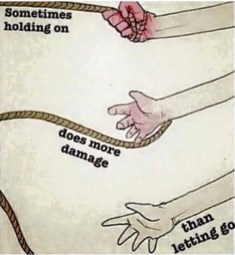
My therapist showed me this meme in session today. She said it reminded her of me. At first, the person is holding on to the rope, as it tears and cuts into his hand. Then, as he starts to let go of the rope, his hand starts to get better. When he lets go completely, his hand is no longer being damaged by the rope at all; he is free from harm.

therapymeme

I’m still holding on to that rope, so very tightly. I’m holding on to all the shit my mother programmed into me, even though it’s hurting me and causing me pain. My therapist is trying to pull me away from that rope, telling me I don’t need to hold on to that anymore, trying to stop the emotional bleeding I am putting myself through. But I pull away from her and instead keep holding on to the rope.

I need to let go.

Compliments

I have a hard time accepting compliments.

When I say I have a hard time, I mean I have a really, really hard time.

The topic came up in therapy on Thursday. My therapist gave me a compliment and I just started deflecting it in any way I could. I had just done the same to a friend earlier that day. I told my therapist about it, and of course she wanted to delve deeper into why I had so much trouble with them.

It’s not that I’m not used to receiving compliments. I’ve received them all of my life, for varying reasons. It was something else entirely.

As my therapist started questioning, I started thinking back and connecting the dots. I started remembering things I thought I had pushed down deep and far away. Things I did not want to remember.

So much was going on in my mind, and it must have shown on the outside. My therapist asked what was going on; my whole demeanor had changed. I didn’t want to talk. I didn’t want to say all of the shit that was going on in my head. I wanted to feel, but I didn’t even know what to feel.

“My mother gets mad when people say nice things about me. She yells a lot.”

It’s something I dealt with my whole life. If it was something she couldn’t take credit for, or if it was something that took the attention off of her, my mother would get angry and I would end up in trouble. When someone would compliment my hair or my looks, my mother did what she could to make me ugly. When someone pointed out how smart I was, I was accused of thinking I was smarter and better than her, and I’d get knocked back into place.

As I sat there, muddling through the shit going on in my head, I started to dig my nail into the skin between my thumb and forefinger. I didn’t even realize I was doing it at first. After a few minutes, my therapist noticed and asked me to stop. But I couldn’t. I had the strongest urge to hurt. I needed to feel pain.

Eventually I pried my hands apart and sat on them, hoping it would stop the urge. I told my therapist that I needed to hurt. It was almost instinctive.

I sat there, awkwardly sitting on my hands, half listening to my therapist and half talking to myself in my head. I couldn’t focus. I wanted to cry. I wanted to scream. I wanted to hurt something.

I tried to listen as my therapist talked about why I could have been needing to hurt. But nothing she said was making sense. I didn’t need to hurt because I felt like I deserved it. I needed to hurt because that’s what I associated with compliments. I needed to hurt because that’s what my mother did to me.

I finally found the strength to mutter out the words “mom hurts.” My therapist asked if I meant what I meant, that my mother hurt me, and I told her yes. I told her some of what happened. And then I started to cry, because I realized just how much the shit my mother had done had affected me.

Of all the things my mother had already taken away from me as a child, she took away the good words people had offered me. She took away any opportunity I had to take in others’ positivity. She turned what should have been happiness into pain.

Pain became a conditioned response. I experienced my mother’s narcissistic rage so often that I just automatically associated compliments and positive comments with the pain and hurt that she inflicted on me. Even in her absence, I am continuing the same response I’ve always had. Except now I am the one inflicting the pain.

I tried to pull myself back together and stop crying. I felt ashamed for crying over something I should have known better about. But I wasn’t crying entirely because of that. I was crying out of grief. Just when I thought my mother couldn’t take any more from me than she already had, she struck again.

I was crying for the little girl who couldn’t feel good about anything. I was crying for the little girl who had to shy away and not be noticed for fear that she would be hurt.

I was crying for me.

Support me, but don’t support me

A few weeks ago, I was sitting in the waiting room of my therapist’s office, admittedly a little fearful and pensive. I had just withdrawn from graduate school the day before and I was still dealing with new memories about my father.

The other therapist came out and talked to me for a bit, and offered to give me a hug. I accepted. Within seconds, I started to cry. She continued to hold on to me and comfort me, but I couldn’t stop crying and I pushed her away. In that moment, I needed that comfort and support and warmth and love. But I pushed it away.

I always push it away.

I lived for so long without any support, without any comfort, without any love. I managed to survive because I never knew what support was. You can’t miss something you never knew to begin with.

Now I have sources of support and I don’t know what to do with them. It doesn’t feel right. I want it, but it still feels so foreign to me. And I don’t know how to ask for it, either. It feels so wrong just to want it, let alone to ask for it.

After I read my Father’s Day card out loud to my therapist in our session on Monday, I found myself crying uncontrollably. My therapist assured me that it was okay to cry, so I did. But I couldn’t stop. My therapist asked what she could do to support me, and I just went blank.

“I’m okay.”

Yea. Really, self? You’re okay? I’m sitting there, nearly blinded by tears, with snot running out of my nose, and I still feel the need to say I’m okay. I don’t know if I’m trying to convince myself when I say it, or trying to convince everyone else.

My therapist told me again she was there for me, and asked what she could do to support me.

“I don’t know. I don’t know. I don’t know.”

Inside, I did know. I wanted a hug. I wanted her to sit next to me. I wanted her to hold me. I wanted that comfort so badly. But all I could say was “I don’t know.”

I was afraid to ask for what I needed. I was afraid of being rejected. It’s easier to not ask at all, then to ask and be turned down.

It bothers me that I still can’t ask for what I need.

It bothers me that I still have trouble acknowledging that I have needs.

Polyfragmented

I have been avoiding my DID again. Sometimes consciously, sometimes unconsciously. In therapy, the topic has barely been brought up because I always have so many issues going on, that managing my DID drops down on the priority list.

I think that it is clear, given the events of the last few weeks, that DID is a problem, and a problem that isn’t going away.

My therapist used a metaphor of a daycare to explain what was going on inside. There are some daycare centers that are clean, organized, running on a schedule, and everyone knows what to do. Then there are daycare centers that are a mess, with no planning in place, children running around screaming, and poop on the walls (I contributed to that part).

My system is like that second daycare. There’s no order, just chaos. My parts are running around, confused and out of control. The caretakers have left the building. It’s a mess. My system is a mess. But it doesn’t have to be, and I know that. I am just so incredibly exhausted from life that I don’t have any energy left to work on myself.

My therapist asked about my long-term goals, if I wanted integration or to live as a multiple. The choice was completely up to me, and my therapist has worked with people successfully on both sides. I hadn’t really thought about it enough, because I still like to wake up and tell myself I don’t have DID, so then I won’t have to think about these things.

I just want to be normal, but I’m pretty sure that ship has sailed at this point.

At one point, my therapist asked me how many parts I thought I had. “Dozens, hundreds, thousands?”

My immediate (denial) reaction in my head was well, I don’t have any parts.

I found myself say out loud, “hundreds…”, but not as an answer. I was surprised that hundreds was even an option. Why does this woman think I have parts at all?

Before I could finish my thought statement, my therapist confirmed, “Hundreds? Okay.”

She said it like she wasn’t surprised at all that I would have hundreds of parts. She confirmed it like it was a normal, expected answer.

I quickly jumped on the defensive. “No, no, I don’t have hundreds of parts. I’m not polyfragmented. I’m not that bad.” Polyfragmented DID results from prolonged, systematic, severe trauma. I didn’t go through that. My life wasn’t that bad. I don’t have any parts. I am not broken. Having that many parts means you are just that much more broken. I’m okay.

I can’t help but wonder why my therapist was so quick to accept my statement as reality. Does she think I am so broken? Does she know more than I do?

I don’t want to be fragmented. I want to be whole.

The return home, Part 2

My therapist knew exactly where I was in my mind. She knew I had reached the point of hopelessness. She also knew the danger that returning to my home of origin would put me in, a danger that I could not see because my mind was so focused on giving up.

My therapist talked about other options. She realized that half my battle was financial, something I had been not-so-upfront with in the past. That is when she brought up going on disability. I’ve never been on any type of government assistance, because I feared it would mean I was a leech like my parents, constantly depending on others to get by. Also, with SSDI, that would make my diagnoses real, and part of me still lives on in denial.

I promised my therapist I would look into it, even though I really didn’t want to go that route. I told her it wouldn’t matter anyway, because it takes months to process, and that is even if I am approved, which is unlikely the first time around. Then my therapist brought up cutting our sessions down to once a week to save money, and I started to panic. I can barely handle myself right now; I cannot imagine going to therapy just once a week.

Then she brought up seeing another therapist, one that is covered by my insurance. That was even more horrifying than cutting therapy down to once a week. I’ve been in an out of therapy for 15 years, and the last few years were some of the worst because Medicaid makes it near impossible to find competent mental health treatment. I was not about to go through all of that again. I might as well just treat myself.

Then reality hit again. “Ethically, I can’t continue to take your money and treat you, knowing that you may end up homeless.”

I sort of knew this already, but I didn’t want to accept it. The main reason I moved to this particular area was because I needed help, and I knew I could get it from her. I started therapy within a week of moving here, before I even got a job. Therapy was, and has been, my priority. And now I felt like I was losing that, too.

I didn’t want to think about it then. I had to get myself back on track. I needed to remember why I was traveling, that I was going to take an exam that was going to better our lives.

I went home after therapy and started packing my bags. I had a list written out of everything I needed. I obsessively checked and re-checked everything. By the time I was done, I was so exhausted that I just went to bed, but I didn’t sleep much because my mind was still racing with anxiety.

I got up at my usual 4:30 time, took a shower, packed my last-minute things, and went to work. I was hoping for a rather uneventful morning, but that proved to be false hope. Instead, I got another realization that some of the people and things I held hope in were no good. The thought of going back home to my parents reemerged in my mind. I reached hopelessness again.

I tried to fight back, but at that point everything was chaos. I wanted to quit my job and never come back. What was the point anymore? No family, no more therapy, no money, no life. The life I was building here was fading away fast. I didn’t know what I was going to do.

Part of me was afraid to make the trip at all, knowing that I was risking throwing myself into the lion’s den. Part of me had given up entirely. And another part of me knew we needed to take this test, and there was no other way to get there.

With Courage and Superbear right alongside me, I went to the train station after work and caught the train back to my home of origin, still struggling through the mush of possibilities in my mind.


The return home, Part 1

Last Friday, I took a train back to the  city I fled 11 months ago.

I didn’t have much of a choice. The graduate schools I am applying to require the GRE for admission – I had never taken it before because it wasn’t required for my first graduate school. The application deadlines are fast approaching (and in one case, very much past) and I needed to take the exam as soon as possible. I tried registering online, only to find out that almost every test location was either closed down, or did not have any available test dates for the next three months. The only option left just happened to be the farthest from my current location, and the closest to my home of origin.

Scrambling, I tried to figure out a way I could even get there. I asked an old friend, out of desperation, if he could take me. He agreed. Because of timing (the test appointment was at 8:00 AM Saturday morning) and distance (an additional 30+ minutes of travel), I had to take the train the day before and stay overnight. It definitely caused some panic.

I was worried about my arrival, because I would be stopping in the center of the city, where all of the buses pass through. Many of my former coworkers travel by bus, and a few of them live in the area. I was worried about someone seeing me and alerting  my mother. But during my therapy session last Monday, my therapist reassured me that the likelihood that someone would recognize me was low. My hair was completely different, and I had lost a significant amount of weight. She encouraged me to work out a plan so I would be out in the open as little as possible. I felt a little better, and less panicked.

And then my week went to shit. Tuesday, I withdrew from graduate school and essentially lost my dream of being a counselor. I was denied for a personal loan, one that I needed in order to get through the summer until I started a new graduate school in the Fall. I had a realization that the people I thought I could depend on were not dependable at all; actually, they ended up hurting me more. I wanted just to go to sleep to avoid the pain, but even that ended up impossible because I was startled awake by nonsense going on close by.

So I spent Tuesday night into Wednesday morning crying. I felt my life crumbling around me. At that point, I decided I should just go home for good. I’m losing everything in the life I was building here, so what else could I do? I decided. Friday, we were going home, and we weren’t coming back.

I walked to work early and sat outside, crying. I felt lost. I was also exhausted, and crying only magnified that exhaustion. I couldn’t deal with the emotional pain combined with the physical pain I am still in, and I ended up leaving work early. Then, cue my emotional break and dissociative chaos I wrote about here.

Somehow I managed to get myself to therapy on Thursday, though I will admit I am not even sure if it was all me. I was a mess. I tried (and failed) to hold it together.

My therapist and I went over what happened in the days leading up to session. I told her how I ended up the closet, which is something that has happened quite a few times before. I reluctantly told her about my plan to return home. I knew it could go one of two ways. My mother would take me in and help me, and I’d have a home and family again. Or she would kill me. That’s what I really wanted. I wanted to go home so my mother would kill me, and I wouldn’t have to worry about doing it myself.

I reached the point of dire hopelessness. There was nothing else left to lose.

They were wrong

“I want to hate him, but I can’t.”

Those words I spoke during my therapy session yesterday have continued to stick out in my mind.

I told my therapist what I had been struggling with in relating to my memory, in a very general way because I wanted to avoid a flashback. I don’t understand how someone could do that. I don’t understand how you can reject your own child.

I tried so hard to hold my feelings inside. Anger, hurt, and sadness were swirling around inside of my heart. I tried to hold in the tears, but that wasn’t working as well as I had liked. Even my therapist could tell I was trying to hold back, and told me it was okay to let it out.

My therapist asked what I would say to my father if I could talk to him right then. My mind started going into overdrive. So many questions and statements started running through my head, and without really thinking, the first thing I said was not even a question or a statement to my father. I said “I want to hate him, but I can’t.”

Despite all of the things he has done to me, and now the rejection I am very much aware of, I still have trouble hating him. I want to hate him. I think he more than deserves it. But somehow, despite being raised by two heartless people, I have a kind and compassionate heart. It’s what allowed me to bury my feelings and take care of my father when he got sick so many years ago. He didn’t deserve my care, to be honest. But he got it.

My therapist asked me again. I ran through a list of questions in my mind, quickly playing out what his responses would be. Then I realized that, it wouldn’t even matter what I asked him or what I said to him. “It doesn’t even matter, he doesn’t believe he did anything wrong.”

I thought I was right. Neither my mother nor my father would ever admit fault. I always just assumed that it was because they believed they never did anything wrong. That is how they (especially my mother) played it off.

But then my therapist asked what my father would say if I told him what he did to me. She asked, “Would he say there was nothing wrong with it, or would he say that it never happened?”

I didn’t even have to think for more than a second before I had my answer. “He’d say that it never happened.”

I grew up being told that people on the outside just wouldn’t understand, that’s why we couldn’t tell. But if that were really true, and nothing was wrong with what my parents did, then why would they deny it? If they really believed that they were right, they would say there was nothing wrong with it. They deny it because they know they were wrong.

All of a sudden, it started to make sense to me. I never thought of how contradictory their line of thinking was.

For so many years, I’ve been blaming myself for what happened. I have been carrying that guilt within my heart. Something must have been wrong with me, a child rejected by her own parents. The only reason that made sense to me was that something was inherently wrong with me. I was the wrong one.

Part of me still believes that. That is why it’s so difficult to work through shit in therapy. I hold a lot of shame because I still believe it was my fault. I need to stop carrying the guilt and the blame. I need to keep telling myself that they were wrong.

My father was wrong. My mother was wrong. They were wrong.

I was just a child, born to parents who didn’t deserve me. I was not wrong.