Knocking on doors

I’m always wrong.

KJ, that’s not true.

Yes it, I’m always wrong. I can’t do anything right.

Who told you that, KJ?

My mother. She says that all the time.

She was wrong. And she’s not here now.

You don’t understand.

What?

I know that I am away from her, but I think she’s still here.

Like she’s inside your head?

No. Like she is here, near me. Right outside. I know she’s not here, but I feel like she is. I know I’m not there, but I feel like I am. She’s still going to hurt me.

By then I was crying. I felt like I was speaking things that didn’t make any sense. It doesn’t make sense for what I know to be so vastly different from what I feel. If I know my mother isn’t here, why can’t I just go on and not be afraid anymore? Why am I still living as if she is right outside my door?

I was crying because I was tired. It’s exhausting being on high alert all of the time. It’s even more exhausting when you know the danger isn’t real anymore, but as much as you try to fight it, you can’t switch off your fear.

People don’t understand what it’s like. I say I’m scared of my mother, they say well she’s not here.

If only it were that simple. It doesn’t matter that, logically, I know my mother doesn’t know where I live. It doesn’t matter that, realistically, her physical presence is lacking. My mind has not caught up to my physical reality. My mind still thinks my mother is here. My mind still believes I am in constant danger because I spent 29 years of my life in constant danger.

I tried to downplay it to my therapist. I told her I was okay. I didn’t want to tell her just how strong my panic was. I didn’t want to tell her I was afraid of opening the door and seeing my mother there. I thought to myself, I just need to get home, and I’ll be okay.

Then I left my therapist’s office, and went downstairs to leave the building only to find that I had been locked inside (it was a holiday — someone in another office must have stopped in and locked the main door on their way out, not noticing their were other cars in the lot). My therapist had already started session with another client and I didn’t want to interrupt. I had nothing else planned for the day. I thought to myself this is okay, I can just wait on the bench outside of her office until she’s done.

I was okay for ten or 15 minutes. Then the panic started to set in. I am trapped in this office building. I can’t get out. I tried to steady my breathing, I tried to stay calm. But the fear and  panic continued to increase. I started to cry. I curled in a ball on the end of the bench and that’s when it all went south. I went from I am trapped in this office building to I am trapped inside my room. Mother locked me inside and I can’t get out.

By the time my therapist finished with her other client, I was a crying, dissociated mess. I could barely breathe. My therapist sat down on the bench with me and tried to help me breathe. She knew where my mind was. Do you know where you are KJ? Look around. I am here with you. You are safe.

I sat for a while, trying to convince myself that I was not at home. I apologized to my therapist (like I always do).

“Why didn’t you ask me for help, KJ?”

“I didn’t want to bother you. I didn’t want to get in trouble.”

“You won’t bother me. And you’re not in trouble. You can just knock on my door and let me know.”

Except it’s not okay. Because I can’t even knock on doors. Bad things happen when you knock on doors. Mommy never wants to be interrupted.

Bad things happen when you knock on doors because my mind still doesn’t realize my mother’s not behind those doors anymore.
I choose crutches

I’ve been struggling in therapy the last few weeks. Topics come up that I don’t want to talk about, things that I know will make me dissociate. I don’t want to go there, so I shut down. Then my therapist gets frustrated, and brings up intensive outpatient, because that is what is in the contract I agreed to in July in order to avoid hospitalization. Then I get frustrated because it seems like she just wants to send me off to IOP.  It makes me feel like she just wants to give up on me. It makes me feel like I’m not good at therapy.

It happened again during Thursday’s session. Her mentioning IOP just made me shut down more. I was hurt. I was angry. But I couldn’t voice any of that.

I ended up writing my therapist an e-mail early Sunday morning.

Sometimes I get frustrated whenever you bring up IOP. I know that’s what we agreed on, but I didn’t know that any time anything goes wrong, IOP was going to be brought up. It just further solidifies my belief that I’m not good at therapy. And I know you said not to judge myself, but that is how it translates for me. That I’m not doing this right. That this is just another of many failed attempts at therapy. And then the others think the same, and then it becomes a battle just to go to therapy. It doesn’t help me. It just makes me shut down more.

I know I can be frustrating. I know you have to repeat things a bunch of times because they don’t get through to me. There are times I really don’t understand what’s going on. There are times I don’t feel like my brain is working. There are times when I am sitting there, but I am not there. I’m sorry for that. I am trying, but I’m not perfect.

Sometimes I don’t want to talk about certain things because someone is telling me not to, or because I know I won’t be able to stay present, or because I am afraid to feel. It’s not that I don’t want to. It’s that I can’t.

I’ve made progress. Maybe you don’t think it’s enough, and maybe it’s not enough on paper, but I think it is. Because I live it. I could be so much worse than I am right now. I struggle, but we figure out how to work through it. I don’t know what else I’m supposed to do.

I’m sorry if this didn’t make sense. I just had a lot on my mind that I’d never be able to say out loud.

She didn’t reply back. I actually told her not to. We were having a session the next day, anyway, and I just wanted to get it out there because I knew I wouldn’t be able to say it out loud.
When I walked in her office this morning, she told me was that she got my e-mail. I immediately apologized. I regretted sending it, because I was afraid it was mean, and that she was going to be mad at me. She assured me that she wasn’t angry, that it wasn’t mean, and that I didn’t need to apologize.
My therapist asked why I couldn’t say the things I wrote in the e-mail to her in person. I told her it wasn’t because of her. I am just so afraid of people sometimes, so scared to communicate. I still feel that talking is wrong. I still feel unable to speak the thoughts in my head. Sometimes I can, and sometimes I can’t. I can’t explain it.
She told me IOP isn’t a punishment. She’s not sending me off to Shady Pines. She doesn’t want to pass me off, she wants to help me. She thinks the program will help with some of the basic things I still struggle with, like eating, daily triggers, and handling my emotions. I know how hard it is for you to get through each day. I know how hard it is for you just to get up in the morning. I see it in you every time you’re here.
Then she started with one of her metaphors.
“Let’s say you broke your leg. Luckily, your insurance covers everything and you have to choose between a wheelchair and crutches. Which do you choose?”
“I choose crutches.”
“But why? Choosing the wheelchair will help you recover faster and easier. With crutches, you’ll still be struggling, and you’ll risk falling and making your leg worse.”
I understood her analogy, but I still insisted on the crutches. I can’t do as much in a wheelchair. Sure, I may recover faster, but at what cost? I won’t be able to do my job in a wheelchair. I won’t be able to get around everywhere I could if I were walking. Half of my ability will be gone.
But with crutches, I can still walk. I can still get around. Sure, I will struggle to keep myself upright. And yes, knowing me, I’ll probably fall over quite a few times. But I’ll still be functioning. I can still hobble around and do what I need to do. Even if it takes me longer to heal, I’d pick the crutches.
In a deeper way, crutches are a less obvious sign that something is wrong. When someone sees someone in a wheelchair, they know it’s serious. No one uses a wheelchair for minor things. When someone sees someone using crutches, they assume well, at least they’re still walking. They’ll be fine. Maybe it’s just a sprain. Maybe you just need a crutch for a little stability. Nothing too serious.
Let me stumble through life on my crutches.
I don’t want to admit that I’m too broken to need a wheelchair.

The future

For the first 29 years of my life, I never envisioned any kind of future. I spent every day wanting to die, because I believed that death was the only chance to escape the hell I was living in.

Then I managed to get away, and I didn’t have to die.

I finally started to envision a future. I was going to be someone. I was going to make a difference. I was finally going to have the life I wasn’t able to have for 29 years.

And then reality hit, and that future started to dwindle away.

The reality that my mental illness will never be accepted. The reality that no matter what good things I do, no matter what I accomplish, my DID and PTSD will put everything into question.

The reality that, even though I’ve escaped physically, my mind has not escaped the terror. I still live in fear every day. I still carry 29 years of hell inside my mind.

The reality that my physical illness will shorten my life considerably. I’ll never have a family. I’ll never enjoy retirement. I’m going to die a lot sooner than I deserve to.

And that makes me angry. It makes me angry that I spent what will be the majority of my life in a prison.

It makes me angry that my mother may very well outlive me. Actually, I think that angers me more than the diagnosis itself. I can accept that I am sick, but I can’t accept the idea that my mother, of all people, could outlive me.

My therapist and I have talked about it a few times. She doesn’t sugarcoat anything for me, which I appreciate (most times). But I’m not so sure she understands the degree of anger and disgust I have over this.

My therapist tells me that yes, it’s possible that my mother will live longer than me, but it won’t be a good life, that my mother doesn’t experience joy and happiness, that her life is and will be empty. Even in a shorter life, I can still experience those things, things that my mother can’t.

But damnit, she still gets to live. I’m not even sure she deserves to be living now, and she sure as hell doesn’t deserve to live longer than me. How did this happen? For all the wrongs she has done, she is rewarded with a life longer than the one I will see. What did I do wrong?

It doesn’t matter that she can’t feel those good things. She can still experience life. She can still wake up every day and not stress about anything. And I get to spend the rest of my life struggling. I get to spend the rest of my life in fear of her, because I will never be not afraid until she is dead. I just want to know what it’s like to not live in fear. What if I never get that chance? What if I die before I know happiness? Then I really will be just like my mother.

My therapist envisions a future for me that I don’t see. To her, these existential circumstances don’t matter. She still believes I can do great things. She believes I can have a better life, and that I can heal.

But all I see is loss. I lost everything before, and now I’ve lost my future.

Can nobody hear me?

I regularly make excuses for the poor behavior of others in my life, especially when their behavior directly affects me.

I excused my father’s part in my abuse because I told myself my mother made him do it (as if she held a gun to his head). I excused my coworker’s behavior a few weeks ago when he called me a bitch several times, telling myself he didn’t know any better because he was raised to treat women that way. I excuse a close person’s consistently offensive behavior, telling myself she just can’t help the way she acts.

I do this not as a way to defend these people, but to defend myself. If I didn’t excuse them, that means I would end up angry. And I don’t want to be angry.

But making excuses only works superficially, because on an intellectual level, I know that my excuses aren’t viable, that these behaviors were/are wrong, and that I really should be able to feel angry and hurt and however else I want to feel. Eventually, my feelings come to the surface, and I can only push them back down so many times before they come out full force.

Last therapy session, I couldn’t push my anger down any more. We were discussing the aftereffects of the letter, about how it made me feel sad. Then my therapist asked what else I was feeling, because it seemed like more than just sadness. Without thinking, I said “I’m angry. All of those fucking idiots, why didn’t they do anything to help?”

I immediately felt bad for what I had said, and apologized to my therapist. When she asked why I was apologizing, I told her I shouldn’t have used those bad words. I said, “it’s not their fault. They didn’t know. I wasn’t their problem. I shouldn’t be angry.”

“Why don’t you want to be angry?”

“Because if I’m angry that means I’m like her, like my mother.”

“Anger isn’t the same as abuse. What your mother did to you, she didn’t do because of anger. Anger is something that everyone feels, and that’s okay. It doesn’t mean you’re going to abuse. It’s okay to be angry.”

I sat there for a minute, still trying to push down what was trying to come out. I looked around the room, trying to think of something else to talk about.

“No, no, I can’t do it.”

“Yes you can. It’s okay to be angry. Anger makes you human.”

I repeated what my therapist told me to myself a few times. Anger doesn’t make me like her. Anger doesn’t make an abuser. Anger is okay.

And then it erupted. Through tears and clenched fists, I let it all out.

I don’t understand. I don’t understand why nobody helped me. I never wanted to go home after school, I tried to stay with the teachers but then the teachers sent a note home and said I couldn’t anymore and then I got in trouble. None of them ever asked why I didn’t want to go home. None of them asked why I wore so many layers of clothing to school, why I was always covering up. No one questioned why a six-year-old girl tried to drown herself. Children don’t just try to kill themselves out of curiosity. No one wondered why a girl would scratch off her own skin. No one questioned my injuries. How many times could a child walk into walls? I wasn’t clumsy. But nobody did anything! They just nodded their heads and moved on!

There it was. My anger. Finally free and out in the open. The anger that was rightfully mine to have. I was a child who had no other way to communicate. A child who was threatened never to tell. And I didn’t. So I tried every other way to speak without using my words.

I could see just by looking at my therapist’s face that she understood. She got it. And she was okay with my anger, and my hurt. “There were all these red flags, all these ways you tried to ask people for help…”

“And they still didn’t hear me!”

There were so many red flags in my childhood. So many. Yet no one wanted to see them. I could have set those flags on fire and waved them an inch away from their faces, and they would have just stood there and talked about the weather.

I am angry. I am angry that these people just perpetuated my hell by not intervening. I am angry that I spent my childhood thinking that it was just normal to be hurt like this, thinking that no one is hearing my cries so this all must just be normal. No one should ever believe that abuse is normal. It should have never had to be my normal.

It’s an anger I am not sure will ever go away.

Daddy’s gone and he took my hope with him

Fuck you, grief, and your shitty timing.

I finally managed to quiet the internal chaos sparked by my father’s death. There’s no longer any fear that the police are coming to get us, there’s no more thinking that we caused his death, and thankfully, no more asking to be with daddy in heaven (because that was hard for me on multiple levels). So all is good, right?

Wrong. I sat down the other day to write an article that was due the next morning, when I was suddenly overwhelmed with grief. I couldn’t stop crying. I tried to distract myself, but it would only work for a few minutes before I would start crying again. I was a mess. At the most random, inconvenient time, my mind decided it was time to grieve.

But why? I don’t miss my father. I hadn’t seen him in nearly a year, and for good reason. He was an asshole. A fucking asshole. I don’t care that some think it rude to speak ill of the dead. I am speaking the truth; a person’s life status does not affect that.

I brought up my emotional struggle to my therapist on Thursday. She assured me it was okay to grieve his death, but I was sure I wasn’t sad about his physical death at all. I was starting to get frustrated because I couldn’t figure out how to put my thoughts into words (another problem I will write about later). My therapist encouraged me to just say what was inside.

After a few more moments of frustration, I stomped my feet on the floor, and through tears, shouted, “I’ll never know why he did it. Maybe my mom made him do it, maybe he didn’t want to. Now I’ll never know because he’s dead.”

That was the loss I was grieving. Not the loss of my father, but the loss of the truth. The loss of knowing why. The loss of the hope that maybe, just maybe, my father loved me. Maybe he just hurt me because she made him do it. Maybe he really didn’t hate me. Maybe he was just doing her bidding because he had no other choice.

I will never know anything. That is why I cry. I want to believe that if my father was alive, he would be honest about his role in the abuse. In some way, I want to believe that knowing would make a difference, that it in some way would change something.

I know it doesn’t change anything.

But there is a part of me that has spent decades holding onto hope that my father loved me. A child needs someone to love them, and I knew from very early on that person was not my mother. So I put all of my hope in my father, even when his actions showed the opposite of love. I needed to hold on to that possibility. I needed that to survive my childhood.

But do I still need that hope now?

I am that little girl, and that little girl is me.

When my therapist asked me last week to write a letter to my younger self, you would have thought she had just asked me to write a dissertation on behavioral neuroscience. It was the last thing I wanted to do. Actually, at that moment, I probably would have rather written that dissertation. Or stuck my head down the toilet. Or both. I didn’t want to write about feelings. I didn’t want to acknowledge any reasons for having any feelings. Blah.

But I knew I couldn’t get away with not writing it. My therapist and I have worked out an agreement so I could stay out of the hospital, and it requires that I participate fully in therapy. I waited until the night before our next session to write it, not expecting that it would turn into the letter that it did.

While I was writing it, I did get emotional. But it was a different kind of emotional. I felt genuine empathy for the child who experienced this pain. I felt the anger she felt. I felt sad for her. But there was a huge disconnect between me and this child. In my brain, we were two different people. I wasn’t yet connecting that we were one in the same.

My therapist asked if I would be comfortable sharing the letter with her in our session on Monday. At first, I was afraid. I didn’t think I did it right. I asked her if she was going to be mad if it was wrong. She explained that there wasn’t really a wrong way to do it, so I said it was okay. She asked if there was anything I needed first. Needs. What are those? For the first time, I did ask for something. I asked if she could sit next to me instead of across from me in her usual spot. It would make me feel less alone. And she obliged.

I started to read the letter. It had been the first time I read it all at once, and the first time I spoke it out loud. As I was reading it, I started to realize that this wasn’t another person. The words on this paper, these words I wrote to this little girl, those words were written for me.

I was the confused little girl who didn’t understand why mommy and daddy kept hurting her.

I was the little girl afraid of her own parents, with nowhere to hide because mommy blocked all the closets and underneath the beds.

I was the scared girl who thought everyone was just meant to hurt her.

I was the empty little girl who believed the only thing inside of her was evil.

I was the little girl who felt so alone, even when she was surrounded by people.

I was the little girl who felt invisible, who tried so desperately to get someone to help her, but no one listened, no one cared.

I was the little girl who tried to kill herself at six years old because she had lost any sense of hope of a life without pain.

I started to read the paragraph about feeling hurt. I felt the heaviness in my heart. As I read the words “I wish there was a Band-aid I could give you that could make your hurt go away”, I broke down entirely. It was like I found out someone I loved just died. I cried so hard I was blinded by my own tears. I needed comfort. I reached out to my therapist and she allowed me to hug her. She held me as I cried (and covered her in tears, drool and nasal discharge), until I calmed down enough that I could see again.

I took a few more minutes fighting through tears, trying to catch my breath so I could finish the letter. After a few failed attempts, I picked up where I left off, and finished reading. I even managed to laugh at the part where I wrote that “something was wrong with mommy and daddy and I guess they missed that memo.” Something was surely wrong with them to say the least, but I know that they shouldn’t need a memo to remind them that they were supposed to love their children.

My therapist encouraged me to keep reading the letter. She said that younger part of me needs to hear all of those things, and that I need to hear it as well.

And as I kept reading the letter, the more I realize that everything she went through was real. The more I realize that everything that happened wasn’t fair. The more I realize that something could have been done to stop the damage.

The more I read, the more I realize I am that little girl, and that little girl is me.

I’ve been such an emotional mess these past few days because of this. I saw it as a bad thing, but my therapist did not. For the first time, I am letting myself feel. After a year in therapy, I am finally feeling sad about my abuse. Apparently, that’s progress.

The mug is broken

You drop your favorite mug. The handle breaks. It’s a clean break, so you grab some glue and dab it on, let it dry, and your mug is good as new again. You can’t even tell it was ever broken.

This time, you drop your favorite mug and it’s not such a clean break. Instead of just the handle, the mug breaks into four or five pieces. You try to glue it back together. It looks good, but it doesn’t hold water so well anymore, slowly leaking through the smallest cracks. So you repurpose it, you put it on the shelf so you can still admire it every day. It still lives on.

Now imagine that same coffee mug. It has taken a plunge from seven feet high onto the hard linoleum floor and broken into a hundred pieces. Chunks of porcelain here, flecks there. You can’t even tell where the pieces belong, they’re so broken.

Some pieces have to be thrown away because they have been so damaged from the fall, they can’t be saved. That leaves empty spaces in the mug, holes that cannot be filled. That means the mug has lost its purpose, because with all of those holes, the mug won’t be able to hold any water.

You make a wholehearted attempt at gluing the mug back together. You take your time, you glue the pieces back with precision. But as you’re trying to fix it, it breaks even more.  As you focus on putting the pieces together on one side, the pieces you glued on the other side are coming undone. Nothing seems to be coming together right. None of the pieces are fitting back together like they’re supposed to.

Then you realize there’s too much missing, too much irreparable damage done. You can’t save that mug, no matter how hard you try, no matter how much time you take, no matter how much patience you have. It’s all a fruitless effort. You need to give up on it. It needs to be thrown away.

Because even if you spent all the time in the world gluing that mug back together piece by piece, there’s not any glue in the world that could ever make it whole again.

I cannot be whole again.

Schizophrenic

“I don’t have DID today.”

It’s a line I give my therapist often. I don’t want to talk about my parts or the inner world or the dissociative chaos that is my life. I don’t want to talk about how broken I am.

But that’s not enough for her. She always has to push me further. Then I shut down. Completely. Because that’s what any perfectly normal person would do, right?

I know it’s not good to deny my reality. I know that by denying my DID, I am denying my parts as well. I know that makes everything worse. But I still do it. Deny, deny, deny.

Then, one time, my therapist asked, “well, how do you explain your symptoms?”

I thought for a minute, wondering what symptoms she could be referring to, since I have so many.

“Maybe I’m just schizophrenic.”

The voices I hear, they are not my parts. They’re just hallucinations. Those feelings of depersonalization? That’s just distorted thinking. My memory problems? The cognitive deficits of schizophrenic disorders. It all fits.

Except it doesn’t. The voices I hear are my parts, the depersonalization is part of my dissociation, and my memory problems are because my parts hold those memories for me. I know that already. I’ve known that since the beginning of my diagnosis. So why do I continue to deny it?

My therapist seemed perplexed by my answer. Why would I want a disorder likely more stigmatized, difficult to treat therapeutically, more debilitating to some? “You would rather have schizophrenia?”

“Yes,” I replied.

“Why?”

Then the truth came out. “Because then I wouldn’t have to acknowledge all of the trauma.”

Schizophrenia is largely chemical, an imbalance of dopamine that is treated with antipsychotics. It can happen to anyone.

DID, on the other hand, is caused by severe trauma. There’s no chemical imbalances, no pills I can take to make my symptoms go away. I am broken, a type of broken that can’t ever be fixed the way it should be.

So yes, sometimes I wish I had schizophrenia rather than DID. Sometimes I wish all of the abuse I went through was just a delusion. Sometimes I wish I could just take a pill or three and quiet the voices and be able to get through the day in peace.

But I can’t.

Denial is making it worse, but accepting the truth is just too hard.

Complex

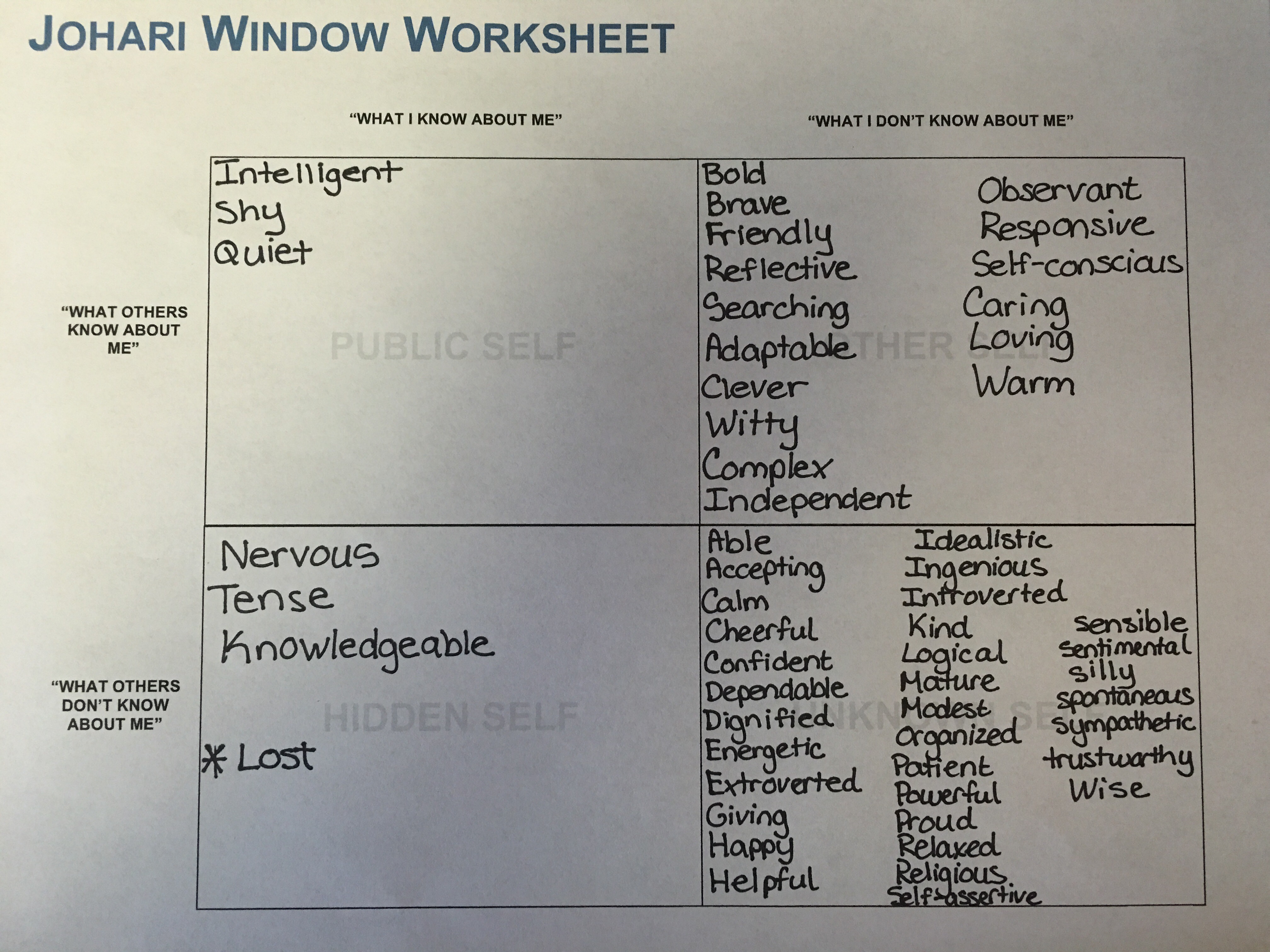
One of the activities in yesterday’s group therapy was to create a Johari Window.

Each person chose six of the 57 adjectives listed to describe themselves, and then chose six for each other person.

It was so easy for me to choose adjectives to describe everyone in group. But when it came to choosing my own, I became frustrated. The adjectives on the list were mostly positive – too positive for my own liking. I struggled just to pick three. Intelligent. Nervous. Tense. Those words were definitely accurate for me. I could never deny my intelligence, even though I oftentimes wish I had less of it. Nervous and tense are words I associate with anxiety, and anxiety is my normal.

Well after everyone else was finished, I was still struggling to finish my own six adjectives. I quickly scanned the sheet again and choose three more: Knowledgeable, quiet, shy. I think knowledgeable pairs with intelligence. I have a lot of knowledge about a lot of things, probably more knowledge than I need. Quiet describes me sometimes, depending on the day, the amount of coffee I’ve had to drink, and how present I am. Shy, for sure. People scare me.

Then I received seven lists, each with six adjectives the others in group used to describe me. I went through the lists and wrote down each adjective in the appropriate window.


Not surprisingly, most people chose intelligent. At least I was right about something about me. I couldn’t argue with that.

Then I came across the words brave, bold, and independent. Everyone put brave. Me. Brave. Clearly they don’t know me, I said to myself. Brave would have been standing up for myself. Brave would have been fighting my mother and telling her to stop hurting me. Brave would have been hitting my father back after he beat me. Brave would have been running home at age 15, not at age 29. Bravery, no. Weakness, maybe.

Bold, I am not. Being bold is being fearless. Bold people don’t hide in the closet when someone knocks on the door. Bold people don’t get scared to check the mail, afraid a letter from home will appear. That is not being bold. Clearly these people don’t know me.

Independent, not me. I can barely decide what to eat for dinner. I can’t make my own decisions, or live my own life. I need other people to make decisions for me. I never had the ability to be independent. I spent more than 29 years in forced dependence on my mother, and now even though I am free, I feel lost without anyone here to make decisions for me.

Then I came across a word that set off a bit of internal rage. Complex. The second list I read through, and someone had circled complex. I blew it off, until the next list had complex circled as well, and then another list, and another. By then, I was just angry. At who, I am not sure. How could these people call me complex? I’m not complex. They don’t even know me.

As I sat with my own thoughts and slight inner rage, I realized the negative associations I had formed with that word. This wasn’t the first time I was told I was complex. I’ve heard it several times before, and never in a positive way. I heard it from therapists as their reasoning for not being able to help me. You’re too complex. Shit, I didn’t know therapists only worked with certain difficulty levels. I’m sorry.

Complex meant I was too complicated, too broken, too difficult to be helped. That word hurt me, multiple times. And here it was, coming up again and hurting me still.

I decided to share my difficulties with that word with the rest of the group. In response, some people explained what that word meant for them, and why they chose it. It wasn’t at all for reasons I had associated complex to be in my head. I was complex because there was more to me to get to know, more than what you see on the outside. I was complex because I was interesting. I was complex, as one of my therapists put it, because the gap between what I think and believe I can do and what I actually do is so large. I don’t believe I can do anything right, or even do much of anything at all. Yet I continually do these great things, and accomplish so much, despite the fact that it all goes against everything I believe about myself. I guess that it complex.

I guess, when I really think about it, I’m definitely not simple – the opposite of complex. Nothing in my life has ever been simple. I admit, at times, I desire simplicity. I crave ignorance. I want life to be uncomplicated. But that’s not going to happen, it didn’t then, it’s not now, and it won’t be in the future. And that’s okay.

Perhaps it’s not so horrible to be complex.

Perhaps those people in my past were just too simple to deal with my complexity.

The Stones of What I’ve Lost

I had group therapy today for my support group. It is something I look forward to every couple of months, even though the topics are somewhat difficult and I always end up crying at least once.

Today was no exception. I was actually doing quite well until the topics of anniversary dates and grief came up. I thought to myself, anniversary dates aren’t a problem for me. I’m over it.

But I decided to write down something anyway. April 25th. The day I tried to end my life by taking a more than lethal dose of aspirin. The day my family found out, and did nothing about it.

The memories flooded my mind and I couldn’t focus on anything else. I felt the pain again, the despair that was all too familiar. I tried to hold back my tears, and retreated back into myself. By the time the topic of grief came up, I was teetering in another place in my mind. I was back in 2008, reliving the pain of that day.

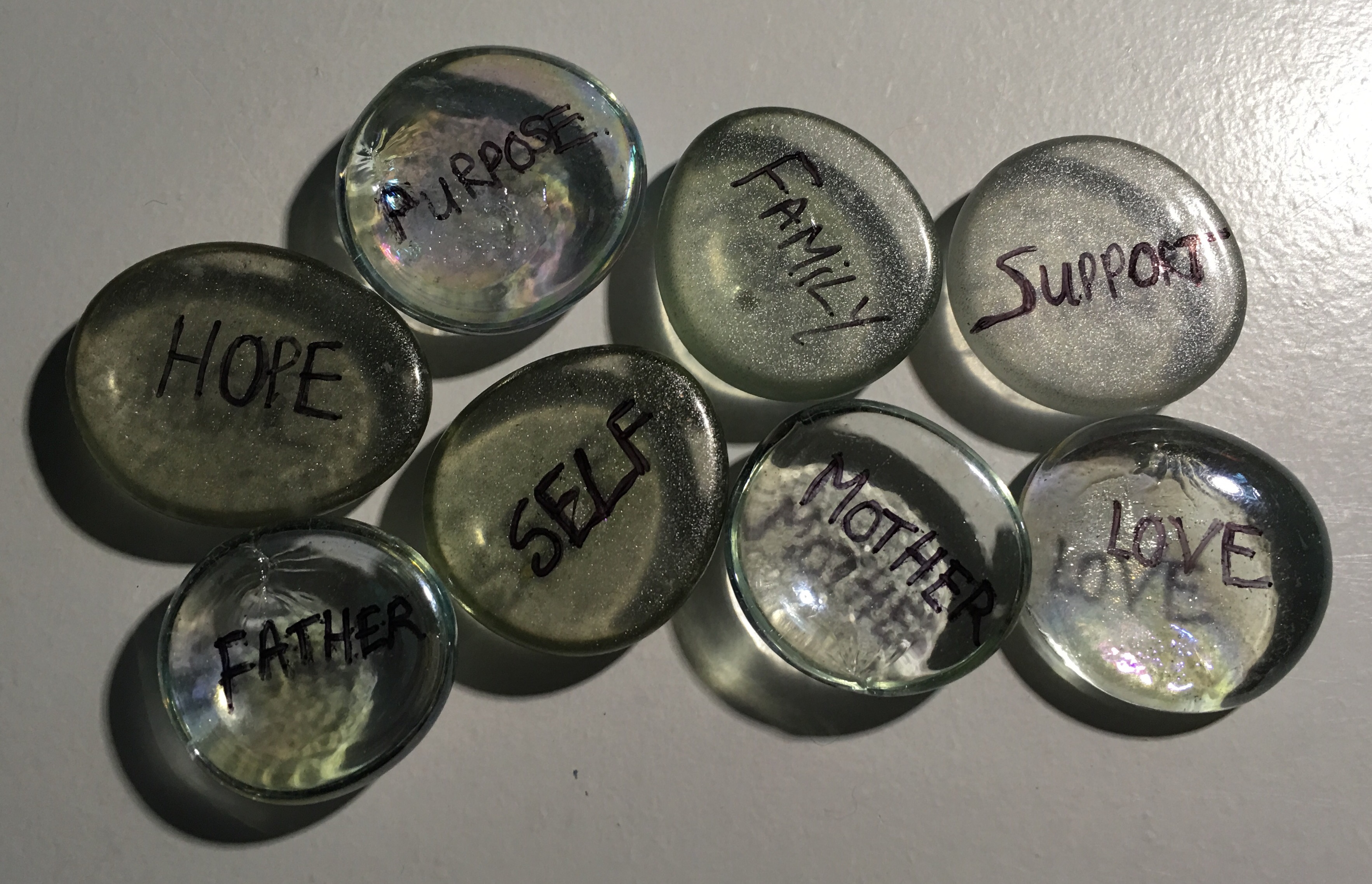
I was able to ground myself enough to work through the rest of the grief session. We each chose eight stones, and had to write something we lost on each one, something we grieved or are still grieving.

It didn’t take long for me to write my losses: Mother, father, family, purpose, self, love, hope, and support.


Simple words, that to the outside world, would never appear to be related to loss or grief. But they were, for me, the losses I still carry with me every day.

The loss of a mother, the mother I never had, the mother I always wanted, the mother I deserved, the mother I will never, ever have.

The loss of my father, not as much in his actual death, but the loss of the father he should have been, the man he should have been, the protector he should have been, the superhero he should have been to me and never was.

The loss of the family I no longer have. I didn’t just lose my parents when I ran away. I lost any connection to my brother. I lost the connection to anyone on my mother’s side of the family. I’m losing the connection to the very little family I have left, and I can’t change that.

The loss of my purpose. I believed so strongly that I was going to be a counselor some day. That is why I went through what I did. I was going to help people. I was going to right the wrongs that were done to me for so many years. But I lost that when my school showed me that my mental illness was all that mattered, not my skills or who I was on the inside.

The loss of self, the loss of my identity. Who am I? I still don’t know. I was never allowed to be anyone or anything other than what my mother told me to be. My identity is so fractured, both literally and figuratively. I’m not even sure that I lost myself, because I question whether or not I ever existed.

The loss of love, the loss of trust, the loss of ability to connect with people. I never experienced the love I should have gotten from the people who were supposed to love me but didn’t. I don’t know how to love because I never learned what love really is.

The loss of hope, strongly felt that April 25th night, when I sat alone, nearly dying, and my family didn’t care. The very little hope I had was shattered forever that night. I could have died, I should have died, and my family didn’t care. The loss of hope I continue to feel day in and day out as I realize the world wasn’t meant for me.

The loss of support, through 15 years of working with some of the shittiest therapists, the loss of support when I left everyone I knew behind so I could escape the hell that was my (former) home, the loss of support I feel when my therapist wants to send me away to the hospital, because even she can’t seem to help me.

I carry these losses in my heart every day. Now I have stones to carry with me, too. Because as much as I would like to throw the stones away, it’s not that easy.

I wish people could see these losses inside of me, and not just on these stones I carry.